In residential architecture, some of the most influential elements are not necessarily the largest.
A staircase occupies relatively little of a home's total footprint, yet its position can influence how rooms connect, how light travels, what visitors see upon entering, and how residents experience the house from one floor to the next.
In ordinary construction, the staircase is often treated primarily as infrastructure. It must meet structural and safety requirements, connect levels efficiently, and fit within the available floor plan.
In exceptional residential architecture, the thinking changes.
The staircase becomes part of the architectural composition.
Its geometry can establish a visual axis. Its materials can introduce craftsmanship. Its railing can become a sculptural detail. Its landings can create moments of pause. Its relationship with windows can transform natural light into a vertical feature of the house.
This is particularly relevant in luxury real estate, where buyers are not simply evaluating how many rooms a property contains. They are experiencing how the architecture organizes everyday life.
A beautifully conceived staircase can make a house feel more coherent, more distinctive, and more memorable without necessarily adding another square foot.
More Than Circulation
Every staircase solves a practical problem: getting from one level to another.
But that is only the beginning.
The placement of the staircase determines how people move through the home. A staircase positioned near the entrance can become an immediate architectural statement. One placed deeper within the residence may create a more private transition between living spaces.
A central staircase can become an organizing element around which other rooms are arranged.
A concealed staircase can preserve a minimalist visual language.
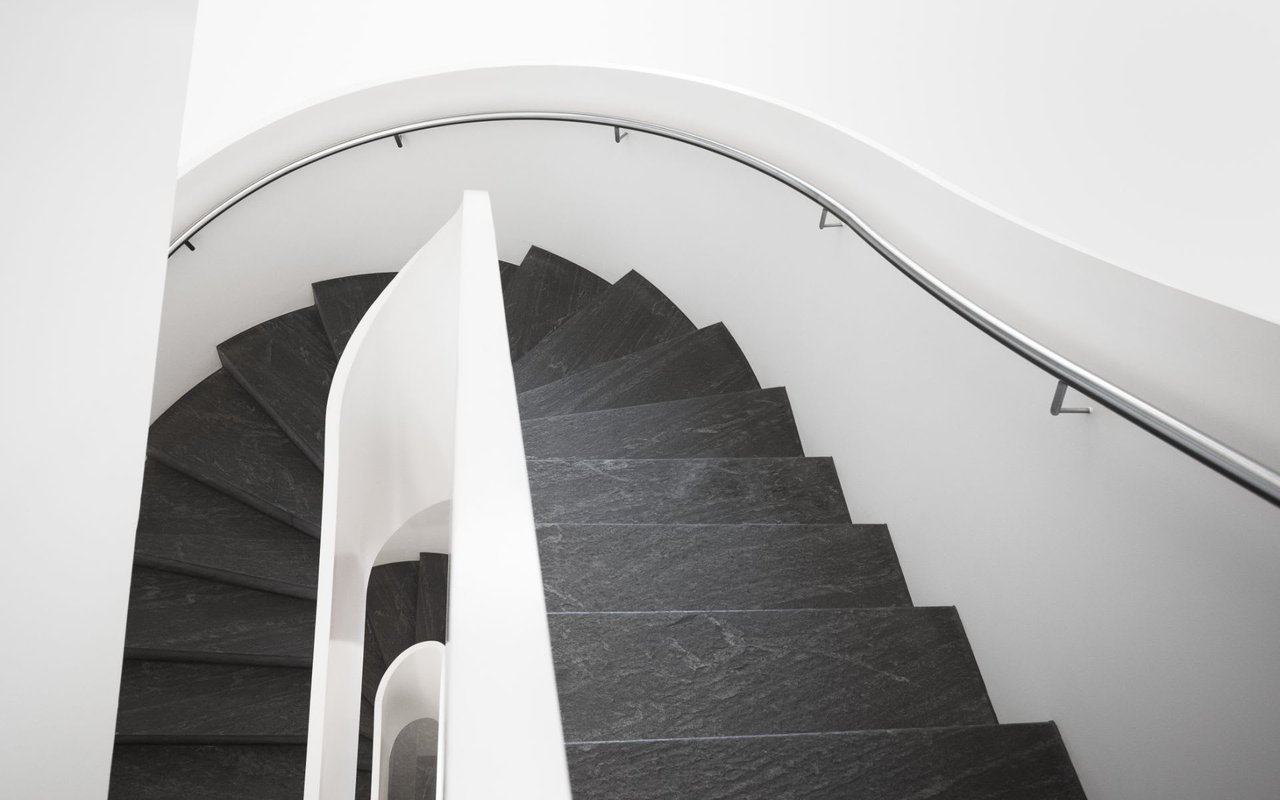
A curved staircase can create movement where a straight staircase creates direction.
A staircase adjacent to a window can introduce daylight into a vertical circulation zone that might otherwise be overlooked.
These decisions affect the character of the entire floor plan.
This is one reason architectural quality cannot always be evaluated from a list of specifications.
Two residences may both have two stories, five bedrooms, and similar square footage. Yet the experience of moving between those spaces can feel entirely different.
The staircase is one of the reasons.
The Importance of Placement
The most successful staircases often feel inevitable.
They appear to belong exactly where they are.
That usually comes from careful consideration of circulation.
A staircase should connect the parts of the house that people actually use, rather than forcing residents to take an unnecessarily long route between levels.
In a large luxury residence, this becomes particularly important.
A home may contain formal living areas, family rooms, bedrooms, offices, outdoor spaces, service areas, garages, and guest accommodations. The staircase becomes part of the system that determines how these zones interact.
If it is too remote, it can make the house feel fragmented.
If it is too prominent, it can dominate spaces that were intended to feel calm.
If it is positioned correctly, it can quietly connect the architecture without calling attention to the mechanics of movement.
The best placement is therefore not simply a matter of visibility.
It is a matter of relationship.
The Staircase and the First Impression
Few architectural moments have as much potential to shape the first impression of a multi-level home as the staircase.
Imagine entering a residence and immediately seeing a sweeping staircase framed by a large window.
The staircase establishes vertical movement, while the window establishes light and depth.
The two elements reinforce each other.
Now imagine the opposite: a staircase tucked into a dark corridor with little relationship to the entry sequence.
Both may perform exactly the same function.
Their architectural effect is completely different.
In luxury residences, the entry experience is often carefully choreographed. The sequence from driveway to front door to foyer to living spaces is designed to reveal the house progressively.
A staircase can become part of that sequence.
It can create a vertical focal point without becoming theatrical.
The distinction matters.
Luxury architecture does not necessarily require visual drama. Sometimes the strongest statement is created through proportion, restraint, and precise placement.
Geometry Creates Identity
Straight, L-shaped, U-shaped, switchback, and curved staircases all create different architectural experiences.
A straight staircase creates a strong visual direction.
It can emphasize length, height, and symmetry.
An L-shaped staircase introduces a change in direction that can create privacy and visual separation.
A U-shaped configuration can be highly efficient while creating a more enclosed architectural composition.
A curved staircase introduces continuous movement.
The curve can soften an otherwise rectilinear interior and create a sense of fluidity between floors.
Spiral staircases occupy a different category entirely. They can be highly sculptural, but their practicality depends heavily on the intended use and scale.
The important consideration is not which geometry is inherently superior.
It is whether the geometry belongs to the architecture.
A Mediterranean-inspired residence may call for one kind of movement. A contemporary waterfront home may call for another. A traditional estate may use symmetry and proportion differently from a minimalist architectural residence.
The staircase should reinforce the language of the property rather than compete with it.
Materials That Become Architecture
The staircase is also an opportunity to introduce material craftsmanship.
Stone treads can create visual weight.
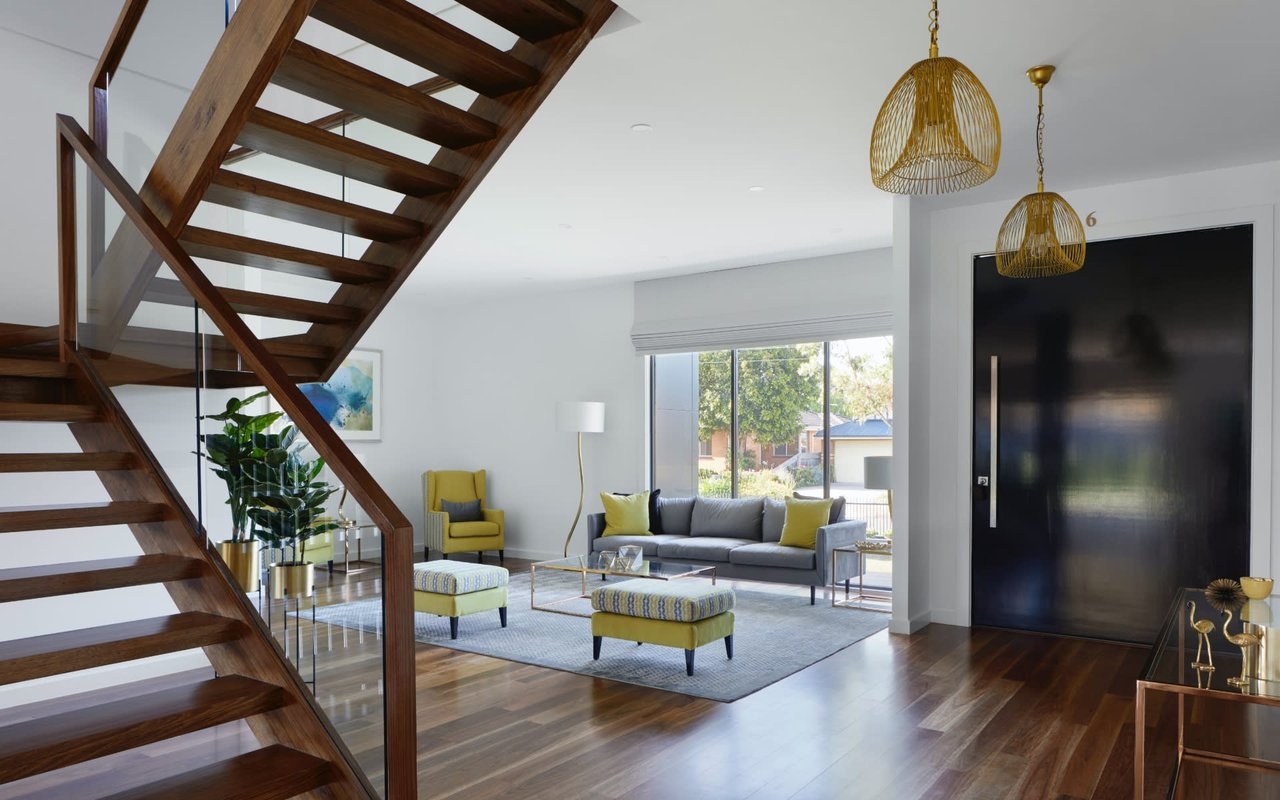
Timber can introduce warmth.
Metal can create precision and lightness.
Glass can reduce visual mass.
Plaster and concrete can create a monolithic effect.
The combination of materials matters just as much as the individual components.
A stone staircase with a heavy ornamental railing communicates something very different from floating timber treads with a nearly invisible glass guard.
Neither approach is automatically more luxurious.
The question is whether the materials are appropriate to the surrounding architecture.
This is where detailing becomes important.
How the tread meets the wall.
How the railing connects to the floor.
How the edge of the stair is finished.
How transitions between materials are handled.
How lighting is integrated.
These details may be almost invisible to someone touring the property casually.
Yet they contribute significantly to the overall perception of quality.
The Railing Is Not an Afterthought
One of the most overlooked elements of staircase design is the railing.
Because it must serve a practical safety function, it is easy to think of it as secondary.
Architecturally, however, the railing can dramatically change the visual character of a staircase.
A thick wood handrail creates warmth and presence.
A slim metal rail introduces a more precise language.
Glass can make the staircase visually disappear.
Custom metalwork can turn the railing into an artistic element.
The choice also affects how open the staircase feels.
A visually heavy railing can define a boundary and create enclosure.
A transparent railing allows sightlines to continue through the staircase.
In a large residence, this distinction can have a substantial effect on how connected different levels feel.
Light Changes the Experience
Staircases are vertical spaces, which means they offer an unusual opportunity to work with natural light.
A skylight above a stairwell can turn the staircase into a changing architectural feature throughout the day.
A tall window beside the stairs can introduce views into the circulation path.
Clerestory windows can bring light into areas where conventional windows may compromise privacy.
Even indirect light can have an important effect.
When daylight reaches stone, wood, plaster, or metal at different angles throughout the day, the materials reveal changing textures and shadows.
The staircase becomes less static.
It becomes a part of the home's daily rhythm.
This is especially valuable in residences where architectural materials have been selected for their tactile qualities.
The right light allows those materials to be experienced rather than simply observed.
The Vertical Experience
One of the defining characteristics of a staircase is that it creates movement through architecture.
A room is experienced from a relatively stable position.
A staircase is experienced while moving.
That creates an opportunity for changing perspectives.
A person ascending may see the living room from above.
They may catch a glimpse of the garden through a second-floor window.
They may see artwork at a different angle.
They may experience the ceiling height of the entry foyer more dramatically from the landing.
This makes the staircase a form of architectural storytelling.
Each step changes the relationship between the resident and the surrounding space.
In a well-designed home, those changing views are intentional.
Landings Create Moments
Landings are often treated as functional requirements, but they can become meaningful architectural spaces.
A generous landing can accommodate artwork.
It can frame a window.
It can create a visual pause.
It can connect a staircase to a gallery corridor.
In some residences, a landing can become almost like a small room.
A chair, console, sculpture, or carefully positioned piece of art can transform it from circulation space into a moment of transition.
This is another distinction between simply having a staircase and designing one.
The latter considers what happens between destinations.
The Relationship With Art
Because staircases are naturally vertical, they can provide exceptional settings for art.
Large-scale paintings can follow the rise of a staircase.
Sculpture can occupy the void beneath a landing.
A carefully positioned wall can create a gallery-like sequence.
Lighting can emphasize a piece as someone moves through the space.
But restraint is important.
A staircase does not need to become an art gallery simply because it has wall space.
The strongest installations often respond to the architecture rather than competing with it.
A single work positioned correctly can have more impact than an entire collection crowded into the circulation path.
Safety and Elegance Can Coexist
Luxury design should never treat safety as an aesthetic compromise.
A staircase must be functional and secure.
Tread dimensions, riser heights, handrails, guards, lighting, and code requirements all matter.
The architectural challenge is integrating those requirements without making them visually dominant.
This is where custom design can become valuable.
A handrail can be engineered as part of the architectural language.
Lighting can be integrated into walls or beneath treads.
Structural elements can be expressed honestly rather than concealed awkwardly.
Safety becomes part of the design rather than an interruption to it.
That is an important principle throughout high-end residential architecture.
The most sophisticated solutions often make technical requirements feel effortless.
Staircases in South Florida Architecture
South Florida offers its own set of considerations.
The region's architectural vocabulary often places a strong emphasis on indoor-outdoor connection, natural light, large openings, clean lines, and landscape views.
A staircase can participate in that relationship.
A vertically oriented window beside the stairs can connect upper-level movement with gardens or water.
A courtyard can become visible from a landing.
A double-height foyer can establish a stronger relationship between the entry and second floor.
In contemporary residences, stairs may also be designed to appear almost weightless, using glass, steel, stone, and concealed structural systems.
In more traditional properties, the staircase may emphasize symmetry, millwork, craftsmanship, and formal proportion.
The best examples respond to their setting.
A staircase should not look as though it could have been inserted into any house anywhere.
It should belong to the architecture, the climate, and the lifestyle the residence is intended to support.
The Staircase as a Long-Term Decision
For buyers evaluating luxury property, the staircase can also reveal something about the quality of the underlying design.
It shows how much attention was paid to circulation.
It can reveal the relationship between public and private spaces.
It can demonstrate the level of craftsmanship.
It can expose whether architectural elements were coordinated or simply assembled.
A staircase is difficult to evaluate independently.
Its real value becomes visible when considered as part of the entire residence.
Does it make the floor plan easier to understand?
Does it connect important spaces naturally?
Does it reinforce the architectural language?
Does it introduce light or views?
Does it feel proportionate to the scale of the home?
Does it appear carefully detailed?
Does it remain visually appropriate even when the home is furnished?
These questions help move the evaluation beyond surface-level finishes.
The Difference Between Expensive and Considered
A staircase can be expensive without being successful.
Imported stone, custom metalwork, elaborate lighting, and dramatic geometry do not automatically create architectural quality.
Luxury is often found in coordination.
The tread thickness works with the railing.
The railing works with the architecture.
The architecture works with the furniture.
The furniture works with the scale of the room.
The lighting reveals the materials.
The materials support the overall character.
Everything belongs to the same conversation.
That is what makes a staircase feel considered rather than simply expensive.
What Buyers Should Notice
When touring a luxury residence, it is worth spending a few extra moments on the staircase.
Not simply to admire it, but to understand what it tells you about the property.
Look at how it begins.
Observe what it faces.
Notice what becomes visible as you move upward.
Pay attention to the quality of the railing and handrail.
Look at how the materials meet.
Notice whether natural light reaches the stairwell.
Consider whether the staircase feels connected to the rest of the floor plan.
And perhaps most importantly, notice how you feel while using it.
Does the movement feel natural?
Does the house reveal something new as you ascend?
Does the staircase create a sense of openness, privacy, ceremony, or intimacy?
These are architectural questions, but they are also lifestyle questions.
MMGLuxury Perspective
In luxury real estate, architecture is often discussed through its most obvious elements: square footage, bedroom count, views, finishes, outdoor amenities, and construction quality.
But some of the strongest indicators of architectural thinking are found in smaller decisions.
The staircase is one of them.
It reveals how a residence handles movement, proportion, light, structure, and connection between floors. It can become a focal point or deliberately disappear. It can express craftsmanship or architectural restraint.
For buyers evaluating high-end property in South Florida, understanding these details can provide a more complete picture of what they are actually purchasing.
A luxury home is not experienced as a collection of rooms.
It is experienced as a sequence.
And the staircase is one of the elements that connects that sequence together.
Final Thought
The most memorable staircases do not simply take you upstairs.
They change how you experience the home.
They frame views, reveal materials, capture light, establish rhythm, and connect different parts of the residence into a coherent whole.
That is the quiet power of architectural detail.
Sometimes, one of the most important elements in a luxury home is the one you use every day without thinking about it.
#MMGLuxury #LuxuryRealEstate #SouthFloridaRealEstate #LuxuryHomes #LuxuryArchitecture #ResidentialArchitecture #HomeDesign #ArchitecturalDesign #LuxuryLifestyle #SouthFloridaHomes #MiamiLuxuryRealEstate #BocaRatonRealEstate #FortLauderdaleRealEstate #WestonRealEstate