Why does a newer four-bedroom home in a guard-gated Davie community sell for less per square foot than a 1976 rancher two towns over in Cooper City? On paper, it looks backwards. Davie has more new construction, more acreage inventory, and a wider range of luxury product. Cooper City is smaller, older on average, and mostly built out. Yet Cooper City's price per square foot has been running higher than Davie's through most of 2026, and buyers cross-shopping the two towns keep asking their agents the same question: is Davie actually the better deal, or is something else driving that gap?
It's the second one. The number isn't measuring house quality. It's measuring how much land the town's zoning code requires underneath that house, and Davie's zoning code requires a lot more of it.
The Number That Doesn't Match the House
In February 2026, Davie's median sale price per square foot was $328, up 6.1% year over year, according to Redfin. Cooper City's median sale price per square foot was $346 in March 2026, also per Redfin, and Movoto's listing-based figures for April and May 2026 put Cooper City even higher, at $373 to $375 per square foot. That's a consistent 15 to 45 dollar gap, month over month, favoring Davie on paper.
If you stopped there, you'd conclude Davie is the value play. But price per square foot only measures the structure. It says nothing about the ground it's sitting on, and in these two towns, that ground is not remotely comparable.
What the Two Towns Are Actually Measuring
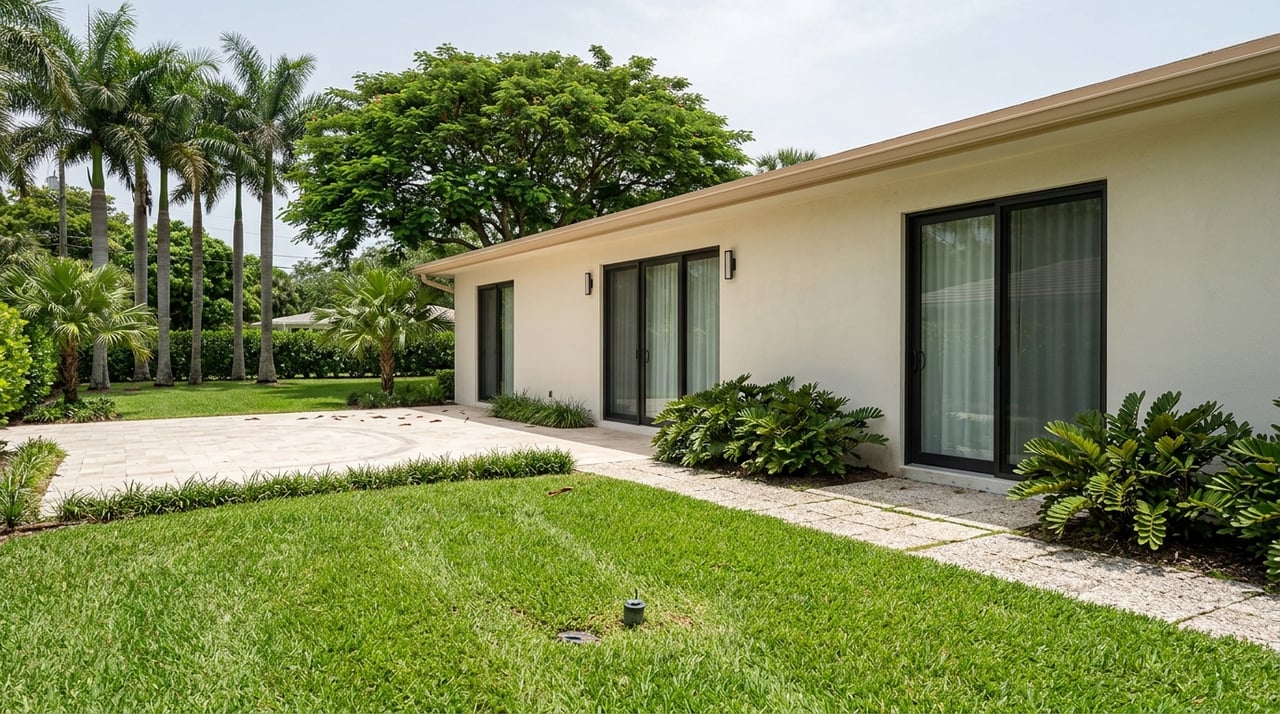
Cooper City's residential neighborhoods are almost entirely platted under standard suburban zoning, which puts most single-family lots at roughly a quarter acre. Davie's zoning map looks nothing like that. A large share of western Davie, from Flamingo Road out toward the Everglades, falls under A-1 agricultural zoning, which the Town of Davie's own planning and zoning code caps at one principal dwelling per acre while permitting horses and accessory structures. That single rule is why Davie's single-family lots run anywhere from about 7,500 square feet in its older eastern subdivisions up to five full acres in the western corridor, while Cooper City's planned communities stay clustered around a quarter acre almost everywhere.
Here's what that means in practice. When a Davie home sells for $328 a square foot on a one-acre A-1 parcel, and a Cooper City home sells for $346 a square foot on a quarter-acre RS parcel, the Davie buyer isn't getting a cheaper house. They're getting a comparable house sitting on roughly four times the land, and the price-per-square-foot metric has no way to account for the difference because it only divides by the structure, never the lot.
| Davie | Cooper City | |
|---|---|---|
| Median price per sq ft (2026) | $328 (Feb, Redfin) | $346-$375 (Mar-May, Redfin/Movoto) |
| Typical lot size | 7,500 sq ft to 5 acres | ~0.25 acre |
| Governing zoning | A-1 agricultural (west), RS (east) | RS, planned unit development |
| Municipal millage, 2026 budget year | ~5.7975 | ~5.845 |
The New Construction Test
If the price gap were really about housing quality, you'd expect Davie's cheaper-per-foot stock to look older or more basic than Cooper City's. It doesn't. Several of Davie's newest guard-gated communities are competing directly with Cooper City's inventory on finishes and amenities, just with more dirt attached:
- Long Lake Ranches, built by GL Homes, guard-gated with lakefront lots and equestrian access, priced from $1.4 million to $3 million
- Riverstone, also GL Homes, waterfront new construction priced from $1.6 million to $2 million
- Imagination Farms, by Pasadena Homes, guard-gated, priced from $1.4 million to $2.3 million
- Estates by Turnberry, new construction delivered between 2024 and 2026, priced from $1.2 million to $1.8 million
- Mystique Estates, built by Toll Brothers, priced from $1.1 million to $1.5 million
- Marigold by Pulte, priced from $900,000 to $1.4 million with smart home features
Every one of those communities sits on lots sized to Davie's zoning framework, not Cooper City's. That's the mechanism at work: newer construction and comparable finishes, spread across more square feet of land per house, pulling the townwide price-per-square-foot average down even as the actual product competes at the same tier.
Why the Tax Bill Doesn't Explain It Either
A buyer's next instinct is to assume Davie must be cheaper because the tax bill runs lower. It doesn't, not meaningfully. Cooper City adopted a municipal millage of roughly 5.845 for its 2026 budget year, while Davie sits close behind at approximately 5.7975. Both towns land right around 5.8 mills at the municipal level, which rules out the tax rate as an explanation for the price-per-square-foot gap. The municipal piece of the bill is close to a wash. What actually drives an individual owner's total tax bill is assessed value combined with county, school board, and any special district millage stacked on top, which varies by property rather than by town.
The Acreage Discount Buyers Don't See Until They Ask
There's one tax lever, though, that only applies meaningfully on Davie's side of the comparison. Property in both Davie and Southwest Ranches can qualify for an agricultural classification that reduces taxable value by 20 to 40 percent when the acreage is actively used for horses, livestock, or crops. Cooper City's quarter-acre lots almost never qualify for this treatment simply because there isn't enough land to meet the use requirement. A Davie buyer weighing a one-acre A-1 parcel against a comparable Cooper City home should be running two different tax scenarios, not one, because the ag classification can change the long-term carrying cost math in a way Cooper City buyers never have to consider.
If You Want More Land Than Davie Gives You
The same mechanism scales up if you keep moving west. Southwest Ranches enforces a stricter version of Davie's rule: its Rural Estates zoning requires a minimum of one full net acre and 125 feet of lot width on every parcel, town-wide, with no eastern Davie-style exception for smaller subdivided lots. That floor shows up directly in pricing. As of June 2026, Southwest Ranches carried a median listing price of $3.28 million, with the market classified as favoring buyers, homes typically selling around 94% of list. A buyer who wants even more acreage than Davie's western corridor offers can find it in Southwest Ranches, but the jump in minimum lot size shows up as a jump in minimum price, not as a bargain.
Two Davies, One Median
There's a second reason a single townwide price-per-square-foot figure for Davie can mislead a comparison shopper, and it has nothing to do with zoning district. It has to do with what's currently under construction on the eastern edge of town. The District, a $1 billion mixed-use project at the southwest corner of Griffin Road and State Road 7, topped out the structural framework for its first phase in February 2026. That phase covers the project's entry promenade and shared infrastructure and is on track for completion by December 2026, ahead of five residential towers still to come that will eventually add 1,292 rental apartments and 36,000 square feet of retail to that corridor. That's a fundamentally different housing product than the A-1 acreage west of Nob Hill Road, and once it leases up, it will be blended into the same townwide median a buyer sees on a portal search.
The practical takeaway is simple. Don't compare Davie to Cooper City, or to Southwest Ranches, using a single blended number for either town. Ask for comps filtered by zoning district, not just by city limits. A Davie price-per-square-foot figure that includes both a one-acre A-1 horse property and a new rental-adjacent unit near SR-7 isn't really describing either one.
If you're weighing Davie against its neighbors and want the comparison run correctly, by zoning district and lot size rather than a townwide average, the Melissa Miller Group can pull that breakdown for any address you're considering. Get Access To Our Private Listings and see what the acreage actually buys before you commit to a number that isn't telling you the whole story.