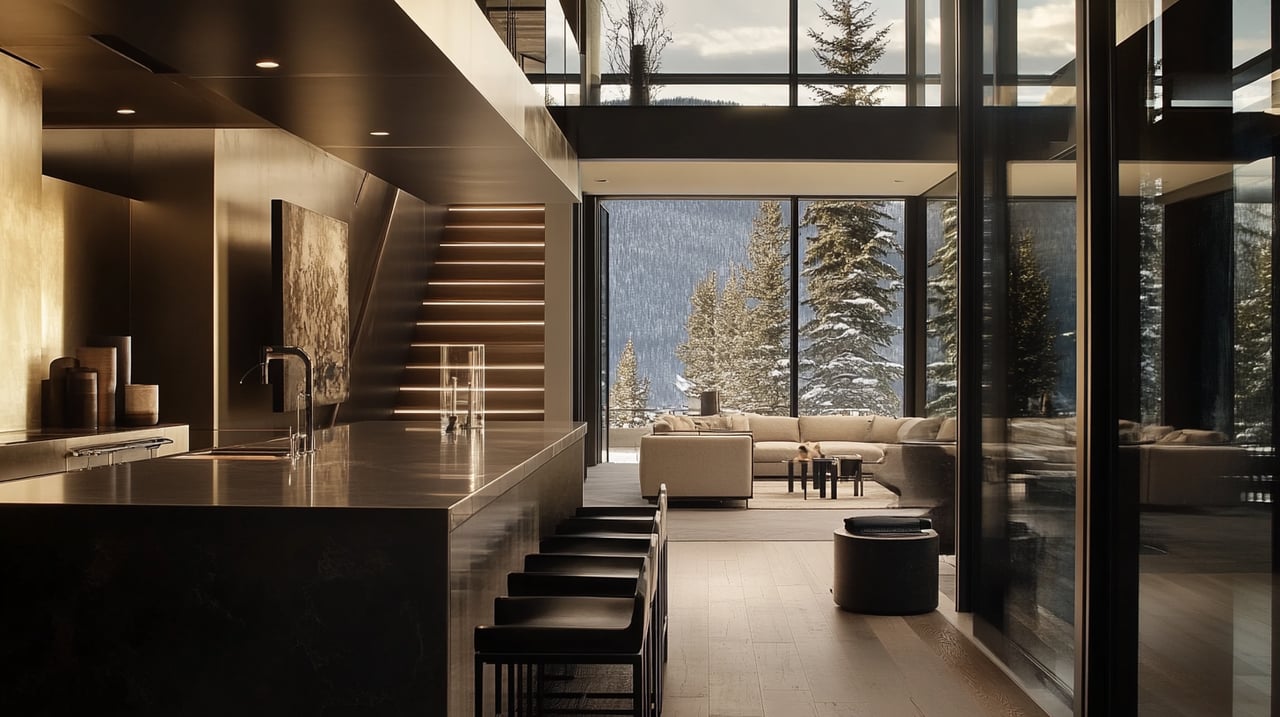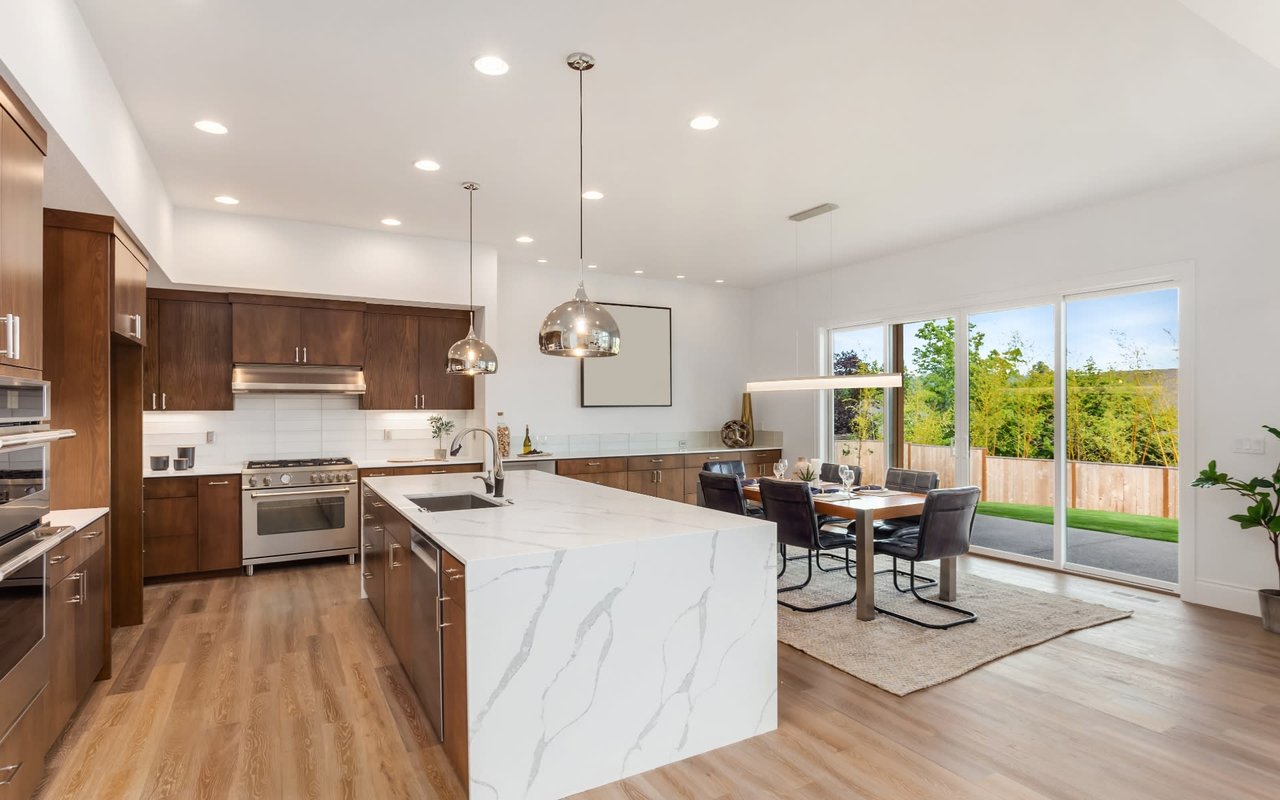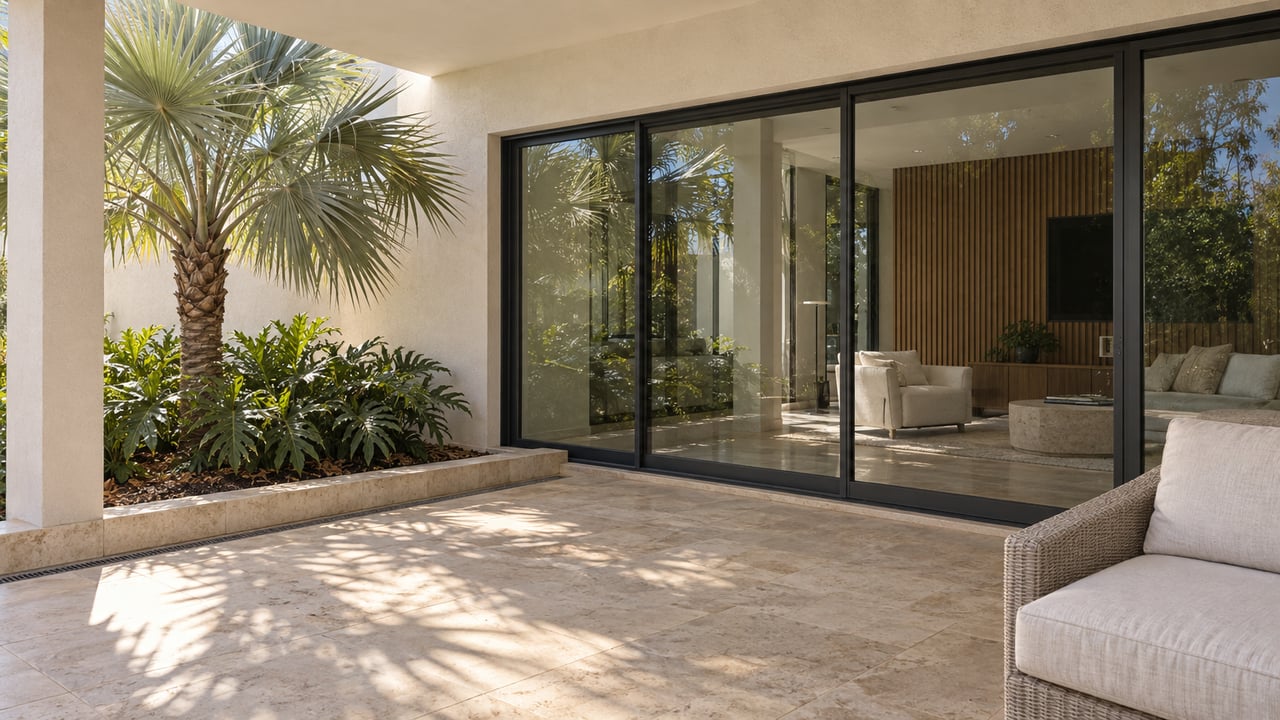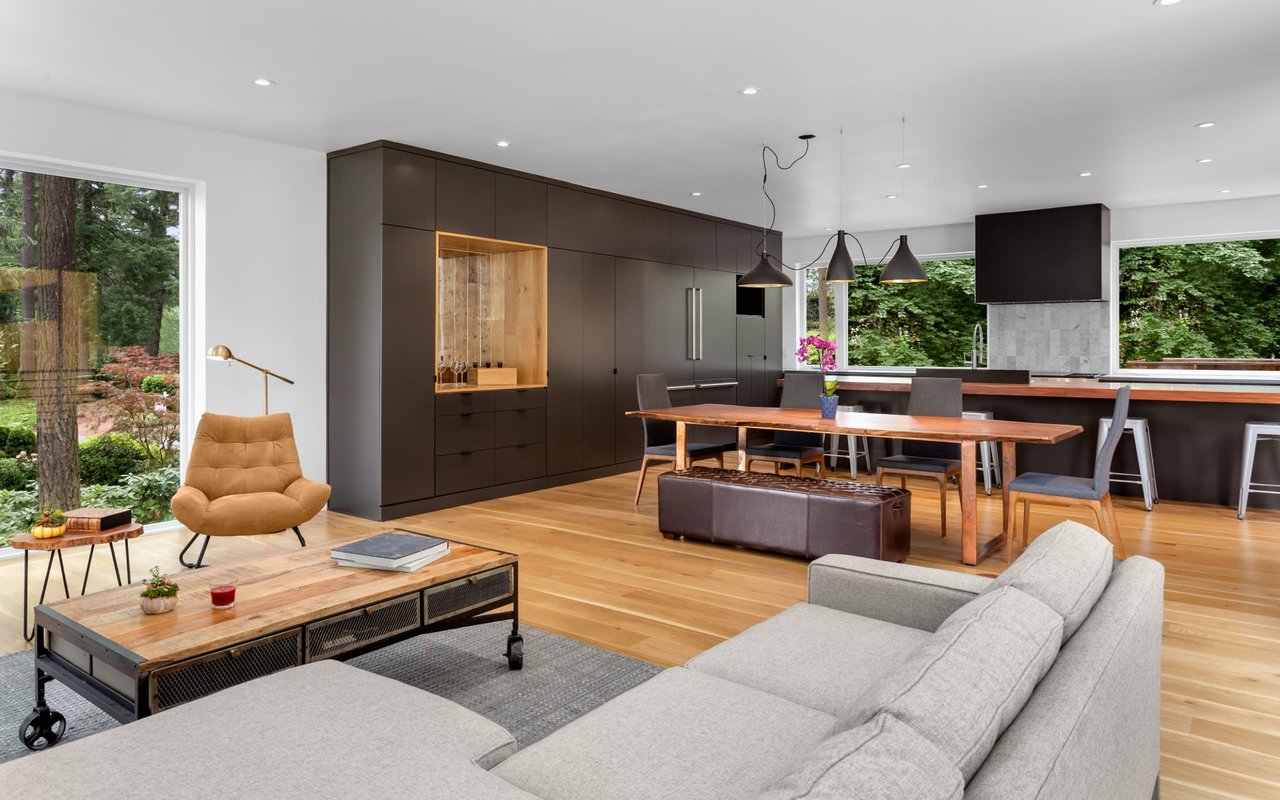
A luxury home does not begin at the front door.
The experience begins earlier.
It may start at the street, where the property first becomes visible. It continues through the gate, along the driveway, past the landscape, toward the entrance, and finally into the home itself.
For some residences, the journey is almost immediate. For others, arrival unfolds across several distinct stages.
A long private drive creates distance and anticipation. A landscaped approach frames the architecture. A motor court establishes a sense of arrival. A covered porte-cochère provides a sheltered transition from vehicle to residence. A carefully positioned entry reveals the interior gradually rather than all at once.
These details are sometimes treated as secondary components of residential design.
They are not.
Arrival is a spatial experience.
It establishes scale, privacy, orientation, and expectations before the first interior room is even seen. It can communicate whether a home is formal or relaxed, secluded or connected, dramatic or understated.
The same is true of departure.
The way a resident leaves the property each morning, returns after a long day, receives a guest, or enters during poor weather is part of the lived experience of the home.
This creates a broader principle for luxury residential design:
A residence should not only be beautiful when standing still. Its sequence of movement should be beautiful to experience.
The First View Is Rarely the Whole Story
Luxury architecture often benefits from controlled revelation.
If the entire residence is immediately visible from the street, the property can communicate its scale quickly, but the experience may be relatively direct.
When architecture is revealed gradually, each stage can create a different impression.
Landscape may obscure portions of the structure. A curved driveway may prevent the full façade from being seen at once. A gate may establish a threshold. A wall may conceal private areas while directing attention toward the entrance.
The result is a sequence.
The visitor does not simply see the house.
They discover it.
This is especially effective on larger properties where distance can be used as a design element.
The driveway becomes more than a path for vehicles. It becomes part of the architecture.
The landscape becomes more than decoration. It controls sightlines.
The entrance becomes more than a door. It becomes the conclusion of a carefully constructed approach.
The Driveway as a Design Element
Driveways are among the most functional elements of a residence, yet their design can have significant architectural consequences.
Width, curvature, material, planting, lighting, drainage, and relationship to the home all influence the experience.
A straight driveway can create a strong axis toward the residence. A curved approach can reveal the property gradually. A circular motor court can establish a formal arrival while simplifying vehicle movement.
The appropriate approach depends on the architecture and site.
A contemporary estate may use a clean geometric driveway that reinforces the building's lines. A traditional residence may use softer curves and layered planting. A waterfront property may organize arrival around the relationship between the residence, garage, and water.
The driveway also needs to function practically.
Vehicles must be able to enter and exit comfortably. Larger cars and service vehicles may require sufficient turning space. Drainage must be considered. Lighting should provide appropriate visibility without creating excessive glare.
The best driveways perform their practical function while contributing to the identity of the property.
Motor Courts and the Luxury of Space
A motor court can be one of the clearest expressions of spatial generosity.
Instead of simply providing a driveway to a garage, the property creates an area where several vehicles can arrive, turn, wait, and depart comfortably.
This can be particularly useful for residences designed around entertaining or frequent guest arrivals.
A motor court can also establish a visual threshold between the public road and the private residence.
Its design may include landscape islands, trees, paving patterns, water elements, walls, or architectural structures that reinforce the sense of arrival.
But scale matters.
A motor court that is too large can feel exposed or overly institutional. One that is too small may create congestion.
The objective is proportion.
The space should accommodate the practical demands of the residence while maintaining an appropriate relationship to the architecture.
In a well-designed property, vehicles do not dominate the experience even when the arrival area is substantial.
Landscape and architectural elements keep the focus on the residence.
The Porte-Cochère and the Transition From Vehicle to Home
The porte-cochère has a long architectural history, but its underlying function remains relevant.
It creates a covered transition between vehicle and building.
In climates where heat, rain, and strong sunlight influence daily life, this can be more than an aesthetic feature.
A covered arrival allows residents and guests to move between car and home with greater comfort. It can provide a practical location for unloading luggage, groceries, or other items. It can also create a clear threshold between exterior and interior.
Its value depends on execution.
A covered drop-off area should have enough clearance for the vehicles expected to use it. Its relationship to the entrance should be intuitive. Lighting should support evening arrivals. Drainage should be considered. The roof structure should integrate with the architecture rather than appearing as an unrelated addition.
When designed successfully, the porte-cochère feels inevitable.
It appears to belong to the residence because the architecture, circulation, and climate all support its presence.
The Importance of the Human Transition
One of the most interesting aspects of arrival design is the transition from vehicle to pedestrian.
The experience changes immediately.
Inside a vehicle, movement is fast and directional. Once outside, the resident becomes a pedestrian and begins to experience the scale, texture, landscape, sound, and atmosphere of the property differently.
A thoughtful entrance acknowledges this change.
The path from parking to door should feel natural. Steps, ramps, landscaping, lighting, and surface materials should create a clear progression.
The distance does not necessarily need to be short.
In some luxury residences, a longer pedestrian approach can be part of the experience. A garden path can slow the transition and create a sense of separation from the outside world.
The important consideration is intentionality.
Every step should feel like part of the property rather than an afterthought.
The Front Door as a Threshold
The entrance door is often treated as an architectural statement.
Material, scale, hardware, lighting, and surrounding landscaping can all contribute to its impact.
But the door also has a practical role.
Its relationship to the entry hall, coat storage, guest circulation, security systems, and everyday access can influence how convenient the home feels.
A dramatic entrance that opens directly into a highly private portion of the residence may create an awkward circulation pattern.
A grand door can also feel disconnected if the space immediately behind it is too small or poorly proportioned.
The best entrances establish a transition.
The exterior remains behind the visitor. The interior begins ahead.
That transition can be formal or informal depending on the architecture.
A grand estate may use a large foyer and long sightline. A contemporary residence may use a more compressed entry that opens dramatically into the main living space.
The entrance does not have to be large.
It has to be purposeful.
Compression and Release
One of the oldest principles in architectural design is the contrast between compression and release.
A relatively narrow or enclosed arrival sequence can make the next space feel larger.
A low-ceilinged entrance opening into a tall living area creates contrast. A shaded pathway leading toward a bright courtyard can produce a similar effect. A narrow garden corridor can make an expansive terrace feel more dramatic when it is reached.
Luxury residences can use this principle to create a stronger sense of scale without simply increasing dimensions.
The experience of entering becomes dynamic.
This is one reason photographs cannot fully communicate the quality of certain properties.
A photograph can show the foyer.
It cannot fully show what it feels like to move toward it.
Architecture is experienced through sequence.
The Role of Landscape in Arrival
Landscape often provides the first layer of architectural context.
Trees can frame the driveway. Hedges can conceal service areas. Planting can direct the eye toward the entrance. Groundcover can soften hardscape. Lighting can establish a visual rhythm after sunset.
The strongest arrival landscapes tend to have hierarchy.
Not every element competes for attention.
A mature tree may become the dominant feature. A water element may mark the entrance. A wall may establish privacy. A simple planting scheme may reinforce the architecture.
This restraint helps the residence remain the focus.
Landscape also influences the perception of distance.
Tall trees and layered planting can make a driveway feel longer. Low planting can create a more open relationship between road and residence. Dense vegetation can establish a stronger sense of retreat.
The landscape is therefore part of the arrival choreography.
The South Florida Arrival
South Florida adds several practical dimensions to arrival design.
Heat, humidity, rain, strong sunlight, landscaping, and outdoor living all influence the relationship between vehicles and the home.
Covered transitions can be particularly useful. Shaded walkways can improve comfort. Landscape needs to be selected and maintained for the local environment. Drainage is important during heavy rainfall. Exterior materials must perform under local conditions.
The architecture also has to respond to the lifestyle associated with the region.
Many residences are designed around outdoor living, frequent entertaining, waterfront access, and vehicle-based movement.
The arrival sequence therefore needs to connect multiple parts of the property.
A resident may move from car to home, home to pool, home to boat, or garage to outdoor entertaining area several times during a typical day.
The best properties make these transitions intuitive.
Garage Placement and Residential Privacy
The location of the garage can significantly influence the character of a property.
A garage positioned prominently on the front façade may make vehicles one of the first things visitors notice.
A side-entry or detached garage can reduce that visual dominance and allow the architecture or landscape to take priority.
Neither approach is universally appropriate.
The decision depends on the site, architecture, property scale, and intended experience.
A detached garage can also create additional flexibility.
It may accommodate storage, workshops, vehicle collections, or other uses while keeping the main residence visually cleaner.
For larger properties, the garage may be connected to a separate service entrance, allowing residents to move between vehicle and home without crossing formal guest areas.
This can improve both convenience and privacy.
Arrival and Departure Should Work Together
A residence is not only experienced when guests arrive.
Residents leave every day.
That means departure deserves the same level of consideration.
The morning sequence may involve walking from the bedroom to the garage, loading belongings, opening gates, and entering the road.
If this route is unnecessarily complicated, the property can feel less convenient despite its visual quality.
Good design considers both directions.
The path should work when residents are arriving with groceries, leaving for work, returning after dark, or receiving visitors.
The garage should connect naturally to the parts of the house that residents use most frequently.
Storage should be positioned where it can support everyday movement.
Lighting should work at night.
The gate and security systems should be intuitive.
These are small details, but they are repeated constantly.
Over years of ownership, repeated experiences often matter more than the occasional dramatic moment.
The Difference Between Formal and Everyday Arrival
Luxury homes frequently have two distinct arrival experiences.
There is the formal arrival used by guests.
And there is the everyday arrival used by residents.
They do not necessarily need to be identical.
A formal entrance may emphasize architecture, landscape, and presentation.
An everyday entrance may connect more directly to the garage, kitchen, mudroom, storage, or private areas of the house.
Separating these experiences can improve both.
Guests receive a clear and intentional introduction to the property.
Residents gain a practical route that supports everyday life.
This distinction is especially useful in larger residences where the formal entrance may be distant from the most frequently used areas.
A luxury home should not require residents to use the ceremonial route every time they return from the supermarket.
The Service Arrival
There is also a third type of arrival.
The service arrival.
Deliveries, contractors, landscapers, maintenance personnel, catering teams, and other service providers may need access to the property.
Their route should be considered as carefully as guest circulation.
A well-planned service entrance can reduce congestion at the primary entrance and preserve privacy.
It can connect directly to garages, kitchens, storage, mechanical areas, and outdoor facilities.
This is particularly relevant for larger estates where service activity can be substantial.
The objective is not to hide service personnel.
It is to give them a practical route that allows them to work efficiently without unnecessarily interfering with residents or guests.
A property that accommodates all three arrival types can feel significantly more organized.
Security Without Institutional Character
Security is an important consideration in luxury residential design, but security features do not need to dominate the architectural experience.
Gates, cameras, access controls, lighting, and perimeter systems can be integrated into the overall design.
The objective is to create controlled access while preserving the residential character of the property.
Landscape can help.
Walls, planting, changes in elevation, and carefully positioned entrances can establish boundaries without making the residence feel defensive.
Technology can also reduce visual intrusion.
Access systems can be integrated into gates and doors. Lighting can support visibility without excessive brightness. Cameras can be positioned discreetly while maintaining appropriate coverage.
Security and hospitality do not have to compete.
The best residential environments can provide controlled access while still feeling welcoming to invited guests.
Lighting the Journey
Arrival changes dramatically after sunset.
A driveway that feels open during the day can become difficult to navigate if lighting is insufficient. Conversely, excessive lighting can flatten the landscape and reduce the sense of privacy.
Good exterior lighting creates hierarchy.
The entrance should be identifiable. Pathways should be safe and legible. Architectural features can receive subtle illumination. Landscape elements can be highlighted selectively.
The objective is not to illuminate everything.
It is to provide enough light for orientation while allowing darkness to remain part of the composition.
This is particularly important in luxury landscapes where mature trees, water, architecture, and views can become dramatically different at night.
A well-lit arrival feels calm and intentional.
A poorly lit arrival feels either uncertain or overly exposed.
Materials Underfoot
The surface of an arrival area influences the experience more than it may initially appear.
Stone, concrete, brick, gravel, tile, and other materials create different visual and tactile qualities.
The material needs to respond to vehicle loads, weather, drainage, maintenance, and pedestrian use.
A beautiful material that becomes slippery when wet or difficult to maintain may create practical problems.
Likewise, a driveway surface should complement the architecture.
The transition from roadway to property should feel intentional.
Material changes can also help establish thresholds.
A different paving pattern may signal entry into the private portion of the property. A pedestrian path may use a contrasting material to distinguish it from vehicle circulation.
These details reinforce the organization of the site.
The Arrival Sequence and Architectural Identity
Every architectural style has a different relationship with arrival.
A traditional estate may emphasize symmetry, axial movement, and formal landscaping.
A contemporary residence may use asymmetry, framed views, long horizontal approaches, and controlled reveals.
A Mediterranean-inspired property may create courtyards, textured walls, planting, and shaded passages.
A minimalist home may rely on restraint, clean geometry, and carefully selected landscape elements.
The arrival should support the architectural language.
When the driveway, landscape, entry structure, and interior foyer feel disconnected, the property can seem assembled rather than composed.
When they share a common logic, the residence feels more complete.
This is one reason architectural coherence matters in luxury real estate.
The property is experienced as a sequence of related spaces.
Arrival as a Statement of Privacy
The distance between the road and the front door communicates something about the property.
A residence immediately adjacent to the street creates a different experience from one concealed behind layers of landscape.
The deeper the arrival sequence, the more opportunity there is to establish separation.
This does not necessarily mean that more distance is better.
A highly urban luxury residence may deliberately maintain a closer relationship with the street.
The important question is what kind of privacy the property is designed to provide.
Some homes seek complete seclusion.
Others create a more open relationship while controlling views through landscaping and architectural orientation.
The arrival tells the visitor how the property understands that relationship.
The Psychology of Returning Home
There is another dimension to arrival that is difficult to quantify.
Returning home is a repeated emotional experience.
After traveling, working, entertaining, or spending time away, the transition back into the residence can influence how quickly the outside world feels distant.
A thoughtful arrival sequence can create a psychological transition.
The gate closes behind the vehicle. The road disappears. Trees replace neighboring structures. The driveway slows the pace. The entrance becomes visible. The interior opens.
Each stage contributes to the sense of returning.
This is one reason residential design can have an emotional dimension beyond aesthetics.
A home is not simply a place where people spend time.
It is also the place they repeatedly return to.
The arrival sequence participates in that ritual.
Designing for Guests
Guests experience the property differently from residents.
They may not know where to park, which entrance to use, or where they are expected to go.
Good arrival design provides intuitive cues.
The primary entrance should be legible. Guest parking should be practical. Paths should be clear. Lighting should support orientation.
A residence can still feel private and exclusive without being confusing.
This is particularly important during events.
Multiple vehicles may arrive at once. Guests may move between indoor and outdoor spaces. Catering teams may be working simultaneously.
A well-designed property can absorb this activity without losing its sense of order.
The arrival area becomes a form of hospitality infrastructure.
The Last Impression
Departure is often overlooked.
But the last few moments on a property can be just as influential as the first.
A guest leaves the gathering, walks toward the vehicle, passes through the gate, and returns to the public road.
The landscape, lighting, architecture, and circulation remain part of that final experience.
For residents, the final transition may be even more frequent.
The quality of the garage exit, driveway, gate, and connection to the road affects everyday convenience.
Luxury should therefore be evaluated across the entire journey.
Not just the entrance.
Not just the foyer.
Not just the view.
The full sequence.
What Buyers Should Observe During a Property Visit
When touring a luxury residence, the arrival sequence can reveal details that are easy to miss if attention is focused only on interiors.
Buyers can consider:
- How the property is first revealed from the street
- Whether the driveway feels appropriately scaled
- The relationship between vehicles and the architecture
- Ease of entering and exiting the property
- Guest parking and circulation
- Covered arrival options
- Connection between garage and residence
- Service and delivery access
- Landscape maturity and maintenance
- Exterior lighting
- Pedestrian paths
- Privacy during arrival and departure
- How the property feels after dark
- Whether formal and everyday circulation are appropriately separated
These observations can provide insight into how the property was designed to be experienced.
The objective is not to judge a residence based on a single architectural feature.
It is to understand the sequence.
The Long-Term Value of a Good Arrival
Arrival design is rarely the most expensive component of a luxury residence.
But it can have an outsized influence on perception.
A well-designed approach can make a property feel more private, more generous, more coherent, and more intentional.
It can also improve practical use.
Vehicles move more easily. Guests know where to go. Deliveries are managed more discreetly. Residents transition between home and car with less friction.
These benefits accumulate.
A dramatic entry may create a memorable first impression.
A practical entry creates a positive experience every day.
The strongest residences achieve both.
The Future of Residential Arrival
As luxury homes become increasingly focused on privacy, outdoor living, security, and seamless technology, arrival design will continue to evolve.
Vehicles may become more automated. Charging infrastructure will become increasingly important. Access systems may become more integrated. Delivery patterns may continue to change. Landscape strategies will respond to environmental conditions and water management.
Yet the fundamental principle will remain.
Arrival is a sequence.
It connects the public world to the private one.
It establishes the first relationship between person and property.
The most successful luxury residences will continue to treat that sequence as part of the architecture rather than as circulation left over after the building has been designed.
MMGLuxury Perspective
At MMGLuxury, evaluating a luxury residence means considering how the property feels and functions from the moment someone approaches it.
Driveways, gates, motor courts, garages, covered entrances, landscape, lighting, and pedestrian transitions can influence privacy, convenience, presentation, and the overall experience of ownership.
For buyers exploring South Florida luxury real estate, arrival can be particularly important because properties often combine significant landscaping, vehicle-based access, outdoor living, and strong privacy considerations.
The objective is to look beyond the front door.
A residence should be understood as a complete sequence of experiences, from arrival to interior living and eventually back out into the world.
Final Thought
A luxury home is often remembered for its architecture, its views, its interiors, or its amenities.
But the experience begins before any of those elements are fully revealed.
It begins with the journey toward the house.
The most sophisticated residences understand that arrival is not simply the act of getting home. It is the first chapter of what it feels like to be there.
#LuxuryRealEstate #SouthFloridaRealEstate #LuxuryHomeDesign #ResidentialArchitecture #LuxuryLiving #LuxuryProperty #EstateDesign #SouthFloridaHomes #LandscapeArchitecture #MMGLuxury